Newman Civic Fellowship
The Newman Civic Fellowship recognizes and supports one community-committed student per participating campus who has demonstrated an investment in finding solutions for challenges facing communities throughout the country. The fellowship provides training and resources that nurture students’ assets and passions to help them develop strategies to achieve social change. Fellows receive learning opportunities focused on the skills needed to serve as effective agents of change in addressing public problems and building equitable communities.
Newman Civic Fellow nominees must meet the fellowship eligibility criteria:
- Be an enrolled undergraduate at UW–Madison
- Have at least one year of education remaining at UW–Madison
- Commit to providing a short reflection piece (video, article, or letter format) to Campus Compact during their fellowship year
Campus Compact during the fellowship year:
Nominee’s institution must commit to helping the nominee identify a local mentor for the duration of the fellowship
Interested UW–Madison undergraduate students can nominate themselves by completing this application.
The deadline to apply was Monday, March 16 at 11:59pm CST. Any questions or concerns? Email José Luis Ramirez, Jr
UW–Madison will select one undergraduate student to serve as the 2026-2027 Newman Civic Fellow. This student will participate in leadership development and learning around civic engagement with a cohort of other fellows from schools around the country.
2025: Devin Guthrie
2024: Amanjot Kaur
2023: Brelynn Bille
2022: Angela Maloney
2021: Beth Allen
2020: Shehrose Charania
2019: Emi Almanza Lopez
2018: Wendy Hoang
2017: Rena Newman
2016: Nasitta Keita
The Newman Civic Fellowship is a core component of Campus Compact’s strategy to build a national network of engaged student leaders who can support one another in building transformational partnerships between campuses and communities. Campus Compact is a coalition of colleges and universities advancing the public purpose of higher education by deepening schools’ ability to improve community life and to educate students for civic and social responsibility.
Newman Civic Fellows are acknowledged for their motivation and potential for public leadership. Newman Civic Fellows demonstrate commitment to finding solutions for challenges facing communities throughout the country. These students represent the next generation of public problem solvers and civic leaders. They serve as national exemplars of the role that higher education can—and does—play in building a better world.
The Newman Civic Fellowship is made possible through the generous support of the Allstate Foundation. Administrative support comes from Campus Compact.
The Newman Civic Fellowship honors Frank Newman, who dedicated his life to creating systemic change through education reform. Frank Newman’s leadership was selfless, optimistic, and determined, spanning an extraordinary career of more than five decades. At the core of Newman’s leadership was a belief in the power of inter-connected individuals to make a difference. Frank Newman had a tremendous impact on American education and its role in the development of citizens. The Newman Civic Fellows are reflections and affirmations of his life’s work. Learn more about Frank Newman.
Engaged Alumni Award
Excellence in Engaged Scholarship Graduate Student Award
Fred Risser Excellence in Engaged Undergraduate Student Award
Louis Korenman Badger Volunteers Award
Newman Civic Fellowship Award
Student Activism Award
2026-27 Recipient Amy Liang
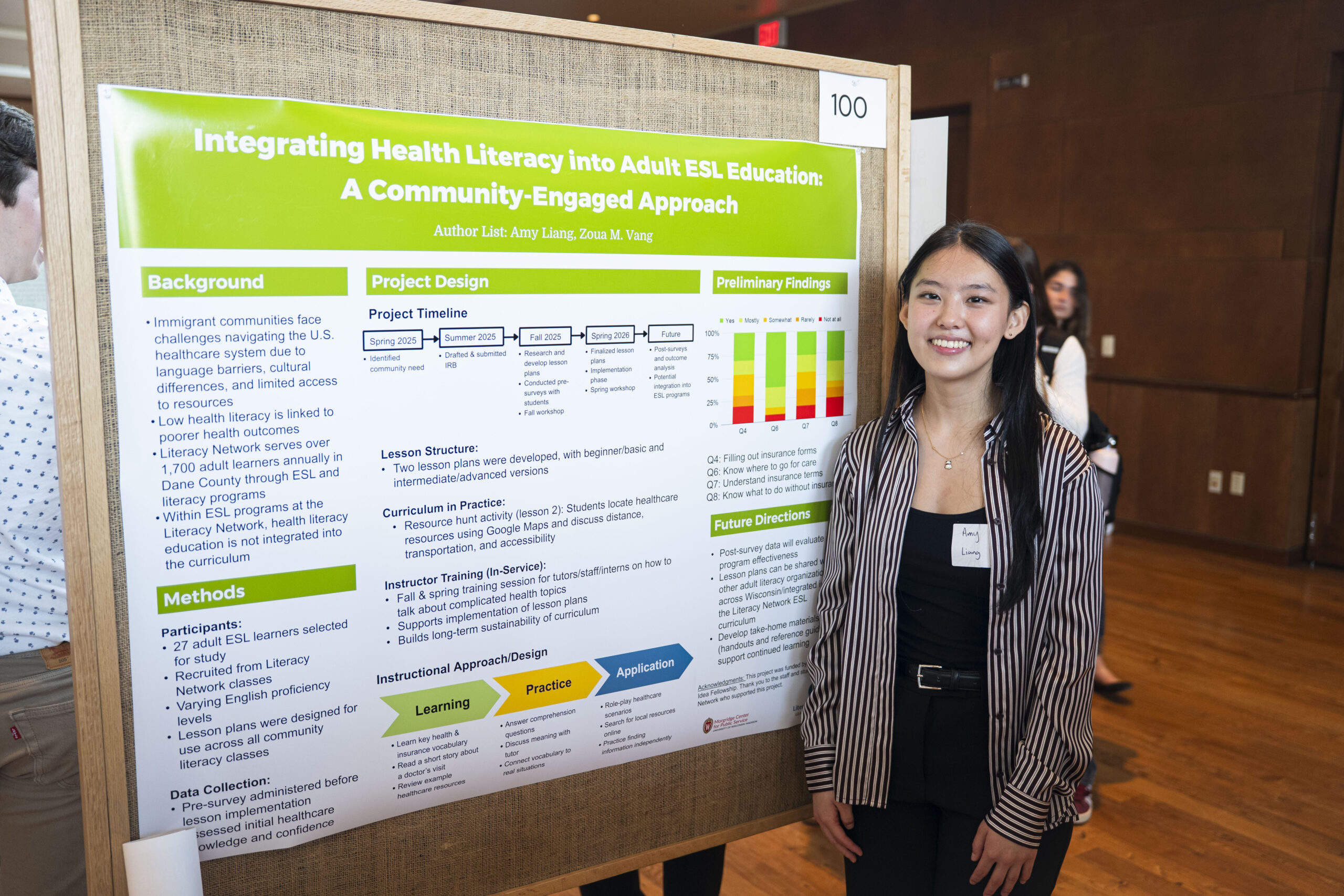
Amy Liang is a senior at the University of Wisconsin–Madison, pursuing a double major in political science and neurobiology along with a certificate in health policy. She is committed to advancing health equity through community-centered and systems-level approaches.
She has demonstrated this commitment through her work with the Literacy Network, where she supported adult learners in building language skills and confidence. Building on this experience, she was selected for the Wisconsin Idea Fellowship, where she is developing a health literacy curriculum in partnership with community members.
On and off campus, Amy is involved with American Community Medical Services, a low-cost clinic serving immigrant communities, and conducts research in the Ausderau Lab focused on disparities in health and access.