Community-University Partnership Awards
The Office of Community Relations and the Morgridge Center for Public Service at the University of Wisconsin–Madison are pleased to offer a unique funding opportunity for community-university partnerships. Funds are being generously provided by American Family Insurance. The Community-University Partnership Award (CUPA) provides recognition and support for exemplary and impactful collaborations between community organizations and UW–Madison faculty, staff, or graduate students.
Community-university collaborations, whether connected to research, teaching, or ongoing projects or initiatives, are a clear embodiment of the Wisconsin Idea and demonstrates UW’s interest in advancing research and knowledge relevant to Wisconsinites, as well as global communities. UW–Madison appreciates the continuous role community partners play in advancing such collaborations and shaping effective impacts.
Three total awards of $5,000 each will be available for use to support or sustain existing community-university collaborations. Funding may be used to support any activities of the partnership, including but not limited to developing a new project, advancing community-based research or learning, or supporting ongoing projects or activities.
The 2026 awardees were honored on Monday, March 2 as part of the Wisconsin Idea Conference.
The proposal should clearly describe the known or anticipated benefits to community partners and to the academy. Partnerships will be evaluated based on their commitment to respect, responsibility, reciprocity, and relevance within the partnership.
- Partnerships should not be brand new (though new collaborators may be involved or new projects may be pursued), but rather demonstrate some history of relationship
- Each application must be co-submitted by both the community partner and campus partner (i.e. a team member from the community organization and campus unit have to submit one application)
The proposal should clearly describe the known or anticipated benefits to community partners and to the academy. Partnerships will be evaluated based on their commitment to respect, responsibility, reciprocity, and relevance within the partnership.
Specifically, applicants should demonstrate how their partnership:
- Works toward social change and community impact
- Addresses a community-identified priority (either originating within a community or co-created by university constituents and community members working together)
- Supports equitable relationships, specifically addressing the partnership’s commitment to respect, responsibility, reciprocity, and relevance.
- Works to build community capacity and provide a sustained positive impact
Funds may be used to support partnerships in any discipline that engage community organizations, public sector entities, or grassroots groups and UW–Madison collaborators. Because these funds are a form of recognition for community-university partnerhsips the budget does not need to explicitly tie to a research project, but should reflect an effort to sustain partnership.
Funding cannot be used for faculty salary, but may be used to compensate staff members, undergraduate and graduate student employees, or community partners. Funds may also be used to purchase supplies and services necessary for the project. Proposals that use all or a portion of funding for community partner expenses will be given extra weight.
2025: Best of Both Worlds: Partnership between Academia and Lived Experience for Youth Empowerment; Building the Path to Success Program for Returning Citizens; Lac du Flambeau Broadband Access
2024: A Community-Engaged Approach to Cardiovascular Disease, Broadening the Impact, Reach, and Sustainability of Restorative Justice, Where do the Babies Go?
2026 CUPA Award Winners
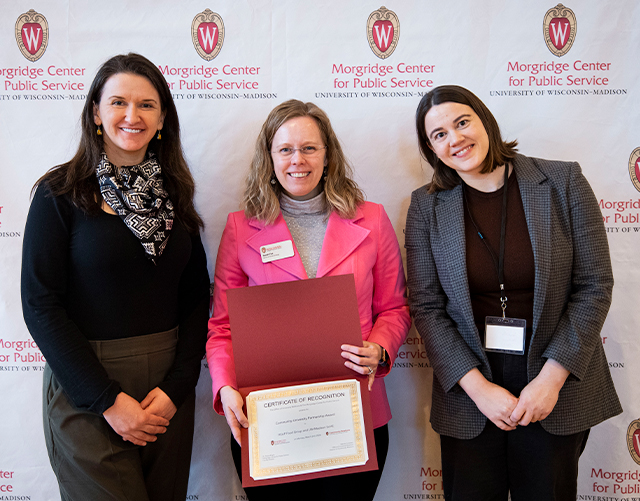
REAP Food Group and UW–Madison SoHE
For over three years, the UW–Madison School of Human Ecology (SoHE) and REAP Food Group (REAP) have maintained a transformative partnership dedicated to building an equitable local food system while cultivating the next generation of community leaders.
Launched in 2022 by Associate Professor of Civil Society & Community Studies Jennifer Gaddis, this collaboration bridges the gap between academic theory and community practice by integrating SoHE student interns directly into REAP’s impactful programs.
Interns have primarily supported REAP’s Farm to School programming, advancing the use of locally grown foods in schools by strengthening school nutrition programs through policy advocacy, marketing to increase student meal participation, and community education.
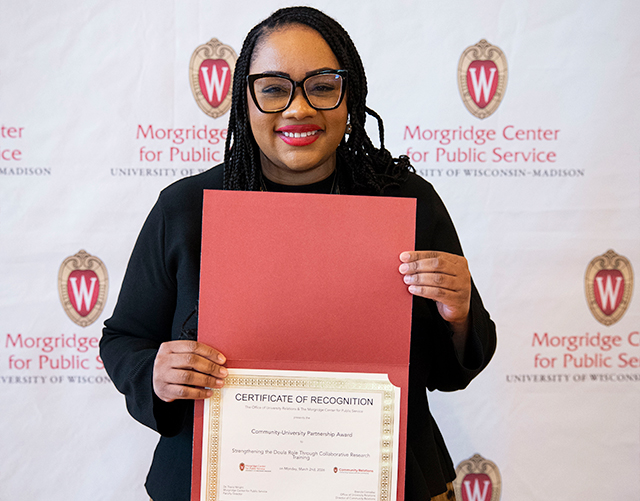
Strengthening the Doula Role Through Collaborative Research Training
A partnership between WI Doulas Of Color and UW–Madison Prevention Research Center
The goal of this collaboration is to strengthen the doula role by integrating birth and postpartum doula training with collaborative research mentorship. DeAnna Tharpe leads birth doula training through WI Doulas Of Color, while Micaela Berry-Smith leads postpartum doula training.
Together, they support doulas of color across the perinatal continuum and mentor them in engaging with research and learning efforts that reflect their lived experience and professional practice. The partnership seeks to equip doulas not only with technical skills, but also with the tools to participate in community-defined research that uplifts the doula workforce, informs systems change, and centers client quality of life.
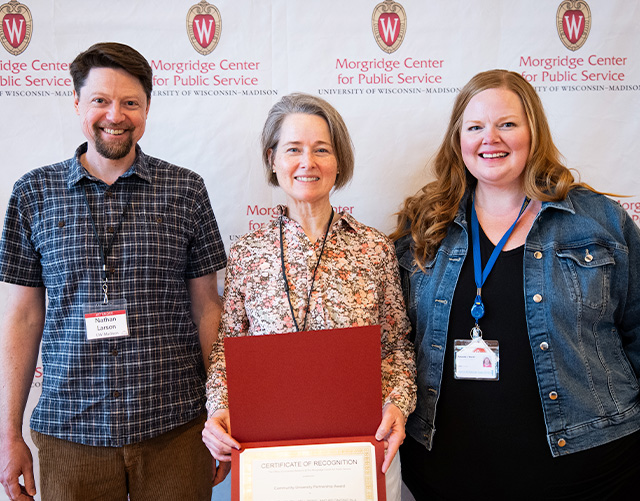
Growing Health, Well-Being, and Belonging in a Community School Garden
A partnership between Mendota Community School, Mindfulness in MMSD, Rooted, Groundswell Conservancy, and the Department of Planning and Landscape Architecture
This community-university partnership focuses on the growth and development of the Mendota Community School Garden and Outdoor Classroom, which is a community-identified priority in support of the health, well-being, and sense of belonging of 4K-5th grade students, families, staff members, and the entire school community at Mendota Community Elementary School – one of eight community schools in the Madison Metropolitan School District (MMSD).
This partnership is grounded in equitable relationships and mutual respect. In particular, it centers reciprocal engagement, mutual benefit, and relevant goals, activities, and outcomes for all partners.