First Cohort Selected for New Early Career Fellows Program for Community-Engaged Scholarship
By Xai Xiong l November 3, 2026
Nine staff and graduate students at the University of Wisconsin–Madison have been selected in the inaugural Early Career Fellows Program for Community-Engaged Scholarship.
The Early Career Fellows Program for Community-Engaged Scholarship is a new, yearlong learning community for staff and graduate students at UW–Madison with an interest in conducting high-quality, collaborative community-engaged scholarship.
Community-engaged scholarship (CES) is defined as: teaching, research and scholarly activities that are performed in equitable, mutually beneficial collaboration with communities to fulfill campus and community objectives.
“We are thrilled to create this new space for early career scholars to collaborate and learn together,” says Dave Lassen, Morgridge Center for Public Service Assistant Director of Community-Engaged Scholarship. “Staff researchers and graduate students are often on the front line of innovative, community-engaged work and we are excited to support them as they build with their community partners moving forward.”
The Early Career Fellows Program for Community-Engaged Scholarship will allow participants to develop a deeper understanding of the theory and practice of quality CES, reflect upon and make progress on their own goals and projects related to CES, cultivate a community of support and shared learning amongst a network of engaged scholars and build comfort and confidence to act as resources and ambassadors for CES across campus.
The following individuals have been named Early Career Fellows:
Eunmi Jeong l Hannah Fry l Jamie Kortanek l Kylie Zochert l Maya Malik l Mo Ondik l Sabrina Sanchez l Sara Ostad l Veronika Mák
Eunmi Jeong
PhD Candidate, The Information School
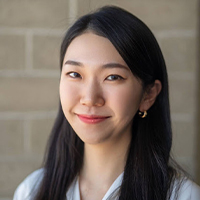
Eunmi (Ellie) Jeong (she/her) is a PhD candidate in the Information School, College of Computing and Artificial Intelligence (CAI). As a sociotechnical collaboration scholar, her research focuses on identifying human factors (e.g., values, goals) and translating them into technology design. She investigates the personal and contextual factors that shape human interactions with technology by integrating theoretical frameworks, empirical research, large-scale data analysis, and participatory design to align human factors with technical requirements better.
Her research centers on amplifying community voices and translating them into actionable technology design in the public sector. She has investigated the perceptions, challenges, and needs of various stakeholders involved in data-driven policymaking, including community members, nonprofit organizations and local government officers. Outside of work, she enjoys hiking, kayaking, flower arranging, attending musical performances and exploring charming local shops.
Hannah Fry
Researcher, Wisconsin Center for Education Research
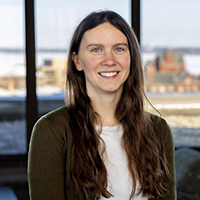
Hannah Fry (she/her/ella) is a researcher with the Innovative Partnership for Advancing Rehabilitation Research and Training (IPARRT) with the Wisconsin Center for Education Research (WCER). She is a clinical rehabilitation counselor and earned her PhD in rehabilitation counselor education from UW–Madison.
Her research and clinical work focus on supporting the lives of people affected by cancer and disability, with a particular emphasis on employment. She collaborates with multidisciplinary teams of researchers, clinicians and community partners to better understand the work-related challenges and identify strategies that promote successful employment outcomes. Outside of work, she raises two rambunctious boys with her partner, trying to spend as much time outdoors and on adventures as possible.
Jamie Kortanek
OTD-PhD Student, Waisman Center
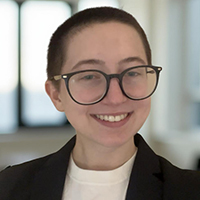
Jamie Kortanek (they/any pronouns) is an OTD-PhD student in the Motor and Brain Development Lab at the Waisman Center. As an autistic autism researcher and aspiring occupational therapist, they are passionate about honoring experiential expertise, advancing anti-ableist care, and combating epistemic injustice in autism research. They approach scholarship, advocacy, and everyday life through the lenses of Neuroqueer Theory and Disability Justice. If any of these topics interest you, Kortanek would love to connect.
They are excited to explore and ultimately co-design various models of community–university partnership that can strengthen the relevance and meaningfulness of research while advancing community priorities.
Kylie Zochert
Graduate Program Manager, Master of Science in Design + Innovation Program
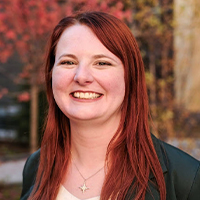
Kylie Zochert (she/her) is the graduate program manager for the Master of Science in Design + Innovation (MD+I) program, where she serves as a key resource for students, faculty, staff, applicants and external partners. As a proud alum of the MD+I program, she designs and leads immersive learning experiences, academic programming, and public events that foster collaboration, strengthen interdisciplinary connections and enrich the student experience.
A self-described change-maker and social innovator, she advises student projects through design thinking, futures and foresight and systems-level inquiry, helping learners prototype ideas and explore creative solutions to complex challenges. Combining strategic thinking with a passion for storytelling and community engagement, Zochert works to create meaningful experiences that drive positive social change.
Maya Malik
PhD Student, Curriculum and Instruction
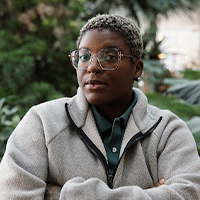
Maya Malik (they/them/theirs), MSSW, is a PhD student in the Department of Curriculum and Instruction with a focus on design, informal and creative education. They’re current work focuses on utilizing arts based, participatory action research methods to combat the trauma of antiblackness, colorism, the gender binary and marginalization that results from the violence of community resource deprivation in the United States and across the globe. During their time in Madison, Malik has been involved with the Whoopensocker literacy program and a Forum Theater group that has performed conflicts from Lorraine Hansberry’s “A Raisin in the Sun” for students and school staff all over the Madison Metropolitan area, Drawbridge with Lynda Barry and the SoulFolk Collective.
Malik earned their MS in social work from the Columbia School of Social Work, focusing on international social welfare and rights for immigrants and refugees. Before starting at UW–Madison they held the position of assistant director of curricular initiatives at Brown University’s Swearer Center for Public Service. Malik is currently a member of the Graduate Student Network (GradSN) of the International Association for Research on Service-Learning and Community Engagement (IARSLCE) and a Knowledge Mobilization action team member of the Community-Based Global Learning Collaborative (CGBL).
Malik is originally from Pittsburgh, PA, but moved to Madison after nearly a decade in the Boston/Providence area. They love music, graphic novels, hiking, all sports (the more unique the better), leading international service learning trips with middle and high school aged youth and trying new things. Malik is a theater kid at heart and never resists a moment to burst into song or participate in improv with youth of all ages.
Mo Ondik
Scientist, College of Agriculture and Life Sciences
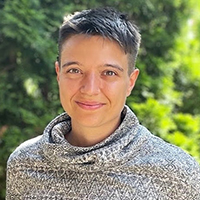
Mo Ondik (they/them) is a scientist in the Organic and Sustainable Cropping Systems Lab, Plant Pathology Department, College of Agriculture and Life Sciences. Mo has a PhD in soil ecology from UNSW (Sydney, Australia) and a BSc in Chemistry-Biology from MIT (Cambridge, MA).
Ondik partners with tribal and non-tribal Wisconsin food producers to upscale production of culturally relevant foods while minimizing tillage via companion cropping and electrical weed management.
On the day-to-day, Ondik travels to and from partners’ farms, transfers and translates agronomic management knowledge from UW experts to on-ground practitioners, performs in-field assays (e.g., biomass collection, yield measurements, and crop staging) and coordinates events to bring food sovereignty workers together into the same space. Ondik finds that connecting regularly in-person is essential to their job as a researcher because they need a foundation of trust and an understanding of their partners’ values to execute on-ground tasks that will have a meaningful impact.
Sabrina Sanchez
Researcher, Waisman Center
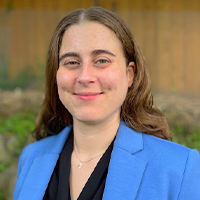
Sabrina Sanchez (she/her) is a recent PhD graduate from the Department of Sociology at UW–Madison. Prior to her PhD training, Sabrina completed a MPH at Ohio State University in Columbus, Ohio where she worked on a community engaged research project to assess the feasibility of a social network based public health intervention. Her research interests include social stratification, especially around race and ethnicity and the associated social and political process that produce disparate health outcome consequences.
She utilizes critical, mixed-methods approaches and is passionate about community engaged research and has worked with a variety of communities. Before grad school, Sanchez did her undergrad at Beloit College. She is from Wisconsin and loves the great outdoors. She can be found hiking, biking, kayaking, gardening and camping with her wife and dog Arlo. On the rare day the weather is inclement she can be found reading inside with her cat, Franky.
Sara Ostad
PhD Student, Life Sciences Communication
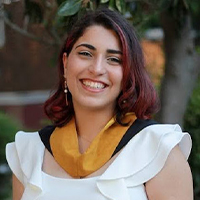
Sara Ostad (she/her) is a PhD student and researcher in the Department of Life Sciences Communication. Ostad’s research interests stretch widely from public engagement around nuclear energy, to disabled communities’ perceptions of new technologies. Overall, Ostad’s work looks at how we can best bridge the gap between the public, scientists, and policymakers when it comes to communicating science, health and technology.
Ostad completed her master’s in environmental policy and management at University of California, Davis, where she worked with majority Hispanic communities to strategically communicate their economic and climate justice concerns and consulted the California Department of Conservation in implementing their new Biofuels grant project aimed to serve Sierra Nevada communities affected by wildfires. When she is not busy working, Ostad likes to collect hobbies including crocheting, ballroom dancing, archery, fletching and fencing.
Veronika Mák
Research Program Coordinator, Waisman Center
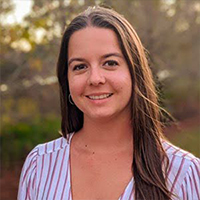
Veronika Mák (she/her) is a research program coordinator in the Pediatric Neuromodulation Lab at the Waisman Center. For five years, her daily tasks surround recruitment, retention and communication for longitudinal research participation for infants and children who have experienced an early brain injury. Her role allows for building relationships with national and local organizations with the aim of involving families with lived experiences throughout the life of research projects.
She completed her undergraduate degree in psychology and education and Spanish (Mount Holyoke College, MA), and master’s degree in cognitive neuroscience (ELTE, Hungary). Outside of work she enjoys gardening, biking, swimming and crocheting.