How Genevieve Lambert Found her Voice Through Civic Engagement at UW–Madison
By Sammie Garrity | May 11, 2026
Genevieve Lambert didn’t come to UW–Madison expecting civic engagement to be the defining factor of her college experience.
“This is kind of embarrassing,” she says. “But I fell into it accidentally.”
Four years later, Lambert spent her time on campus helping students navigate election cycles, advocating for more accessible pathways towards civic engagement and promoting policy change.
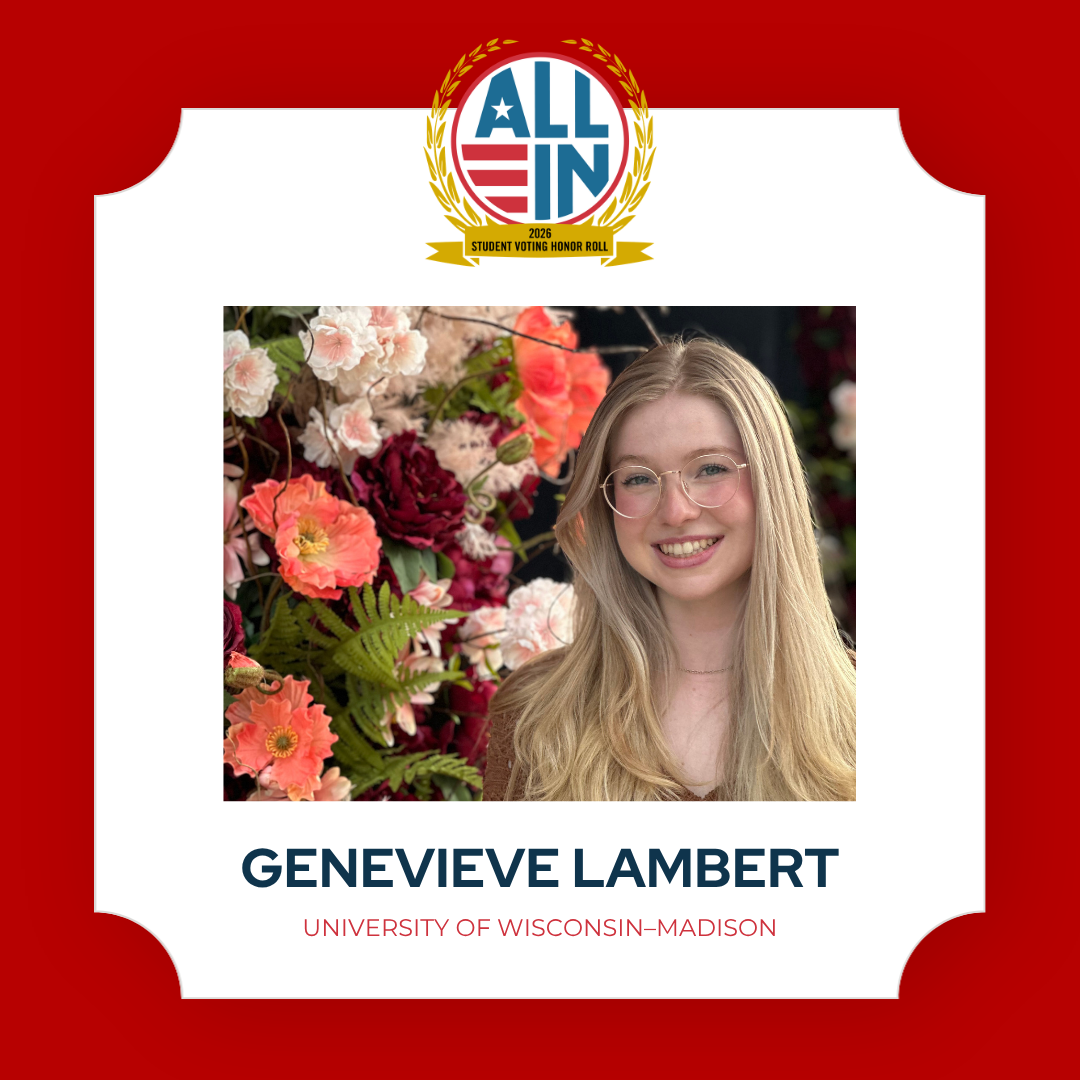
And all of that hard work is being recognized nationally, as Lambert was recently selected to the ALL IN Campus Democracy Challenge 2026 Student Voting Honor Roll, which honors students across the country for their nonpartisan voter engagement work.
She first began her civic engagement career through a communications pathway, joining the American Civil Liberties Union (ACLU) Student Alliance and managing their social media. She went on to a similar position within the UW–Madison Student Voters Union (SVU) where she created social media posts detailing voter registration requirements, election details and other helpful information for student voters.
“I came to really appreciate uplifting student voices in politics, and I saw all of the barriers that they were facing,” Lambert says.
This social media work later grew into leadership roles, positions which Lambert self-described as her civic duty, not necessarily a natural desire. She became vice president and later president of SVU, working to restructure the group and create new advocacy opportunities for students.
She also took on a position with the Andrew Goodman Foundation, an organization that sponsors campus ambassadors who do nonpartisan voter engagement. There, she is a student ambassador and campus champion, working to increase student voter turnout and civic participation on UW’s campus.
But throughout all of these roles and responsibilities, Lambert has one favorite civic engagement memory — working as an election official during the 2024 presidential election.
“I was able to help a lot of first-year students vote, many of them for the first time,” she says. “That was a really great moment of connection to this university.”
Moments like these, she says, reinforce how involved students are at UW, especially when it comes time for important elections.
“We have enormous voter turnout on this campus,” Lambert says. “It’s really great.”
And while these face-to-face interactions give her a sense of student engagement trends, much of her work is focused on behind-the-scenes advocacy, working to make voting accessible for everyone.
This involves trying to amend and strengthen university policies like expanding participation exemptions for poll workers, and implementing stronger protections for exam and election day overlap.
“We wanted to make that mandatory: no midterms on election day, so that no one is trying to negotiate with their professors to allow them to vote,” Lambert says.
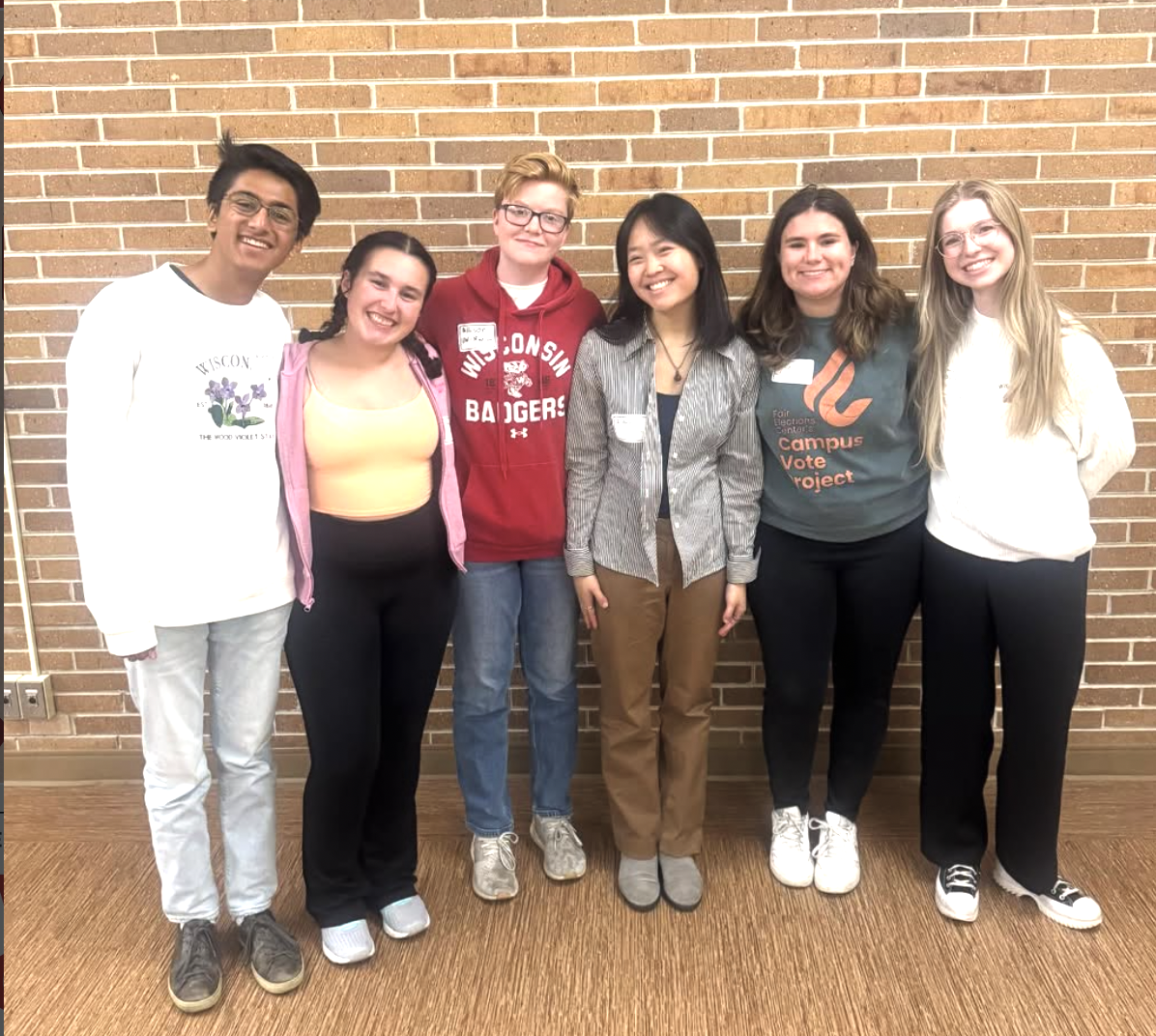
This work expanded through her work with the Associated Students of Madison (ASM) as a Shared Governance Chair. In this position she appoints students to governance committees, ensuring they feel supported and heard in decision-making spaces.
“I just saw that as an extension of my voter advocacy work,” she says. “It’s basically just another avenue to get students’ voices out there.”
And while Lambert has made great strides through her advocacy, she still feels like there needs to be more done at an institutional level.
For example, she points to a long-running effort to allow students’ Wiscards to count as a valid voter ID, a common and longstanding request from much of the student body, and a barrier that keeps many students from voting.
UW–Madison does give students the option to obtain a free campus-issued voter ID, and offers multiple different locations across campus to obtain them, including the Morgridge Center for Public Service.
Lambert, however, argues that most students use their Wiscards on a daily basis, saying that it would make more sense to just have the Wiscard be a compliant ID. It would also reduce barriers for out-of-state students who have to show proof of enrollment alongside their voter ID.
“For years and years, we were told that the Wiscard could not be a voter ID because it would be too much work to change the way it looks,” she says.
Even now, when the Wiscard is being actively redesigned, their request is still being denied. In the face of rejection, however, Lambert holds steady that her work remains fulfilling and that she and her colleagues will continue advocating for the study body.
“Fighting the good fight is something that’s very important to me,” she says.
Much of that fulfillment comes from her connection to community, something she has found both inside and outside of civic engagement spaces. In part, she found this through playing Dungeons and Dragons, a cooperative, storytelling game where players create characters, explore fantasy worlds and overcome challenges.
Coincidentally enough, the community she formed around this game is where she actually met the former president of SVU for the first time.
As she reflects on the past four years and as her time at Madison comes to an end, Lambert is most proud of these communities, especially the ones she built around civic engagement.
“I love that this is such a big institution and even if it takes you a hot minute you will find your people here,” she says. “I found these spaces where we’re doing good work and we really genuinely care for each other,” she says.
After she graduates in May, Lambert will be pursuing law school and a career in civic engagement, hoping to continue working elections and potentially enter a career in election law.
For a person who four years ago “accidentally” stumbled upon this work, she has made great strides in making it a central part of her life, guiding her collegiate career and a future towards enacting change.