Bolstering Innovative Engagement: Disability Justice through Participatory Action Research
Each week at the University of Wisconsin–Whitewater, four students step out of their roles as students and into the role of researchers. What sets their work apart is that the research doesn’t come from outside observation or distant theory — it’s grounded in their own lived experiences as college students with disabilities.
Research mentorship for the team is provided by Dr. Matthew Wolfgram at the Wisconsin Center for Education Research (WCER), and by Dr. Courtney Wilt, who is assistant professor of special education at UW-Whitewater. The four student researchers, who together with their mentors make up the Disability Justice Collective, are Bella Zeit, Kennedy Vahovick, Odin Ehrets and Breanne Lessard.
 Zeit is a senior at UW–Whitewater studying human resources management with a certificate in disability studies. She also has cerebral palsy and generalized anxiety disorder. Zeit says prior to joining the project, she wasn’t quite used to her disabilities being seen — from an outside perspective — as a strength.
“I was very happy, because I felt like an identity that I had sometimes had shame about was positive to them [research mentors] and positive to the project,” Zeit says.
For about two years, Wolfgram and Wilt have been working with this group of students as they developed research and advocacy skills to promote disability justice on college campuses.
Last year, Wolfgram and the research team received a $7,000 grant from the Morgridge Center for Public Service to advance their community-based research. The Disability Justice Collective focuses on participatory action research (PAR), a collaborative form of research that brings together community stakeholders and researchers to better understand co-developed questions.
Here, the community consists of college students with disabilities who collaborate with staff and researchers to shed light on how they navigate their college experiences. To Wolfgram, community-based research means authentically engaging community members and centering their lived experiences in all aspects of the research process.
“It’s central that the students be involved in all, or almost all, aspects of the research that are feasible,” Wolfgram says. “Writing the academic papers — maybe sometimes that gets saved for just the professors to do and get that credit, but that’s not how you should do things.”
The student researchers have lived experiences of facing inaccessibility on campus, which allows them to provide credibility to the research they are doing to improve the lives of students with disabilities. The grant money has gone entirely to the student research team, Wolfgram says, which has helped them gain momentum during the past year.
“The special thing about PAR is, I have never been given so much agency to talk about something that is so central to my identity,” Zeit says. “I always felt like things had been done to me or for me … but this gave me an outlet where I was really a very valued voice, and it just made me feel so special and really widened all sorts of opportunities for me.”
Zeit is a senior at UW–Whitewater studying human resources management with a certificate in disability studies. She also has cerebral palsy and generalized anxiety disorder. Zeit says prior to joining the project, she wasn’t quite used to her disabilities being seen — from an outside perspective — as a strength.
“I was very happy, because I felt like an identity that I had sometimes had shame about was positive to them [research mentors] and positive to the project,” Zeit says.
For about two years, Wolfgram and Wilt have been working with this group of students as they developed research and advocacy skills to promote disability justice on college campuses.
Last year, Wolfgram and the research team received a $7,000 grant from the Morgridge Center for Public Service to advance their community-based research. The Disability Justice Collective focuses on participatory action research (PAR), a collaborative form of research that brings together community stakeholders and researchers to better understand co-developed questions.
Here, the community consists of college students with disabilities who collaborate with staff and researchers to shed light on how they navigate their college experiences. To Wolfgram, community-based research means authentically engaging community members and centering their lived experiences in all aspects of the research process.
“It’s central that the students be involved in all, or almost all, aspects of the research that are feasible,” Wolfgram says. “Writing the academic papers — maybe sometimes that gets saved for just the professors to do and get that credit, but that’s not how you should do things.”
The student researchers have lived experiences of facing inaccessibility on campus, which allows them to provide credibility to the research they are doing to improve the lives of students with disabilities. The grant money has gone entirely to the student research team, Wolfgram says, which has helped them gain momentum during the past year.
“The special thing about PAR is, I have never been given so much agency to talk about something that is so central to my identity,” Zeit says. “I always felt like things had been done to me or for me … but this gave me an outlet where I was really a very valued voice, and it just made me feel so special and really widened all sorts of opportunities for me.”
 The collective has met weekly, sometimes twice a week, working to theorize academic ableism and discover more about why higher education is so difficult and marginalizing for students with disabilities. Wolfgram has found that for this research, the community-engaged and participatory components are key to the rigor and impact of the work.
“I could come in and I could be like, ‘Okay, I’m ready to write the paper, so I’ll just write it,’” Wolfgram says. “But actually, if we pause that impetus to rush and just keep working together, we can come up with something better that I wouldn’t be able to do, because it’s not informed by experience. I’m not a college student managing a disability while I’m trying to get a college degree.”
Some of the focuses of campus inaccessibility that the students have brought to the research team are at social events like football games, which are known to be traditional parts of campus culture. Wolfgram says high-energy events like that can be physically exhausting and alienating for students with disabilities, and part of the research they are doing is working toward acknowledging the exclusionary nature of some of these activities for students with disabilities.
“College is not easy for anybody,” Wolfgram says. “I think prioritizing the accessibility of all students would take the pressure off students with disabilities to advocate for themselves all the time.”
The Disability Justice Collective had the opportunity to present at Research in the Rotunda in 2024 and meet Gov. Tony Evers. At their current stage, they have submitted a research paper to be reviewed by a top-tier journal in special education research. They will also be giving lectures, sharing some of their insights and experiences with having a disability on campus. If the team sees more funding in the future, they would be interested in expanding their work to exploring barriers to the workforce for recent graduates with disabilities.
By Sophie Wooldridge
The collective has met weekly, sometimes twice a week, working to theorize academic ableism and discover more about why higher education is so difficult and marginalizing for students with disabilities. Wolfgram has found that for this research, the community-engaged and participatory components are key to the rigor and impact of the work.
“I could come in and I could be like, ‘Okay, I’m ready to write the paper, so I’ll just write it,’” Wolfgram says. “But actually, if we pause that impetus to rush and just keep working together, we can come up with something better that I wouldn’t be able to do, because it’s not informed by experience. I’m not a college student managing a disability while I’m trying to get a college degree.”
Some of the focuses of campus inaccessibility that the students have brought to the research team are at social events like football games, which are known to be traditional parts of campus culture. Wolfgram says high-energy events like that can be physically exhausting and alienating for students with disabilities, and part of the research they are doing is working toward acknowledging the exclusionary nature of some of these activities for students with disabilities.
“College is not easy for anybody,” Wolfgram says. “I think prioritizing the accessibility of all students would take the pressure off students with disabilities to advocate for themselves all the time.”
The Disability Justice Collective had the opportunity to present at Research in the Rotunda in 2024 and meet Gov. Tony Evers. At their current stage, they have submitted a research paper to be reviewed by a top-tier journal in special education research. They will also be giving lectures, sharing some of their insights and experiences with having a disability on campus. If the team sees more funding in the future, they would be interested in expanding their work to exploring barriers to the workforce for recent graduates with disabilities.
By Sophie Wooldridge
This story is a part of a series highlighting recent recipients of the center’s community-based learning and research grants, which support the development of new community-based learning courses and community-based research projects.
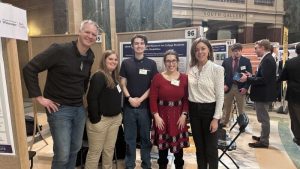
(L-R): Dr. Matthew Wolfgram, Kennedy Vahovick, Bella Zeit and Dr. Courtney Wilt. Photo courtesy of Disability Justice Collective
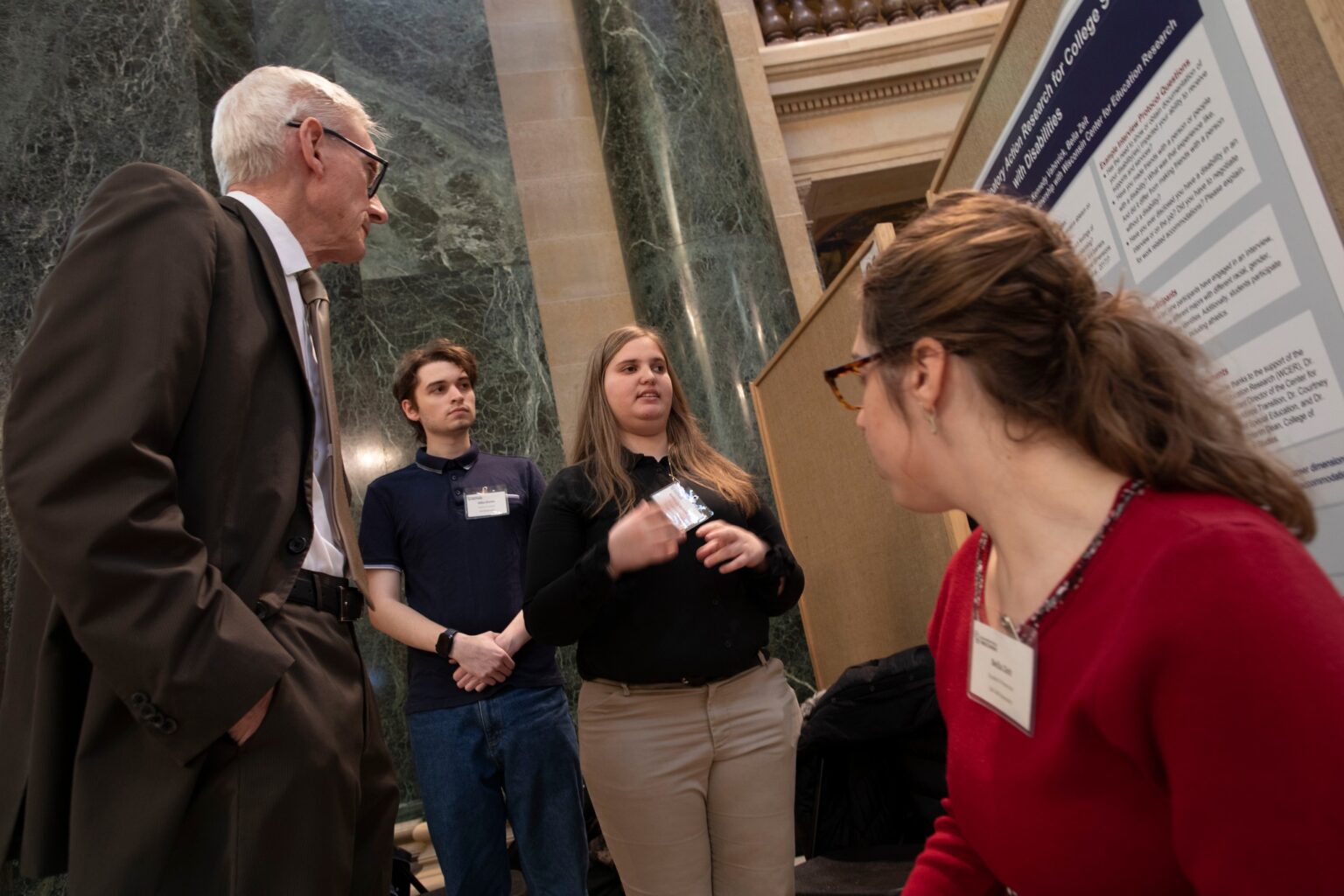
Wisconsin Governor Tony Evers, left, listens to students, from left, Odin Ehrets, Kennedy Vahovick and Bella Zeit explain their participatory action research (PAR) for college students at the Wisconsin Universities Research in the Rotunda at the State Capitol in Madison on Wednesday, Mar. 6, 2024. (UW-Whitewater photo/Craig Schreiner)
This story is a part of a series highlighting recent recipients of the center’s community-based learning and research grants, which support the development of new community-based learning courses and community-based research projects.