Bolstering Innovative Engagement: Student Journalists get Hyperlocal
Last semester, UW School of Journalism and Mass Communication Professor Sue Robinson developed a community-based learning course to train students in how to build relationships in local Madison communities and collaborate on content that advances dialogues on persistent problems.
The course, “J475: Collaborative Storytelling Skills: A Community-based Learning Course for Professional Communicators,” used a $5,000 course development grant from the Morgridge Center for Public Service. The grant, Robinson says, helped her pay some of the student reporters and the community partners who are educating them to create content and host two events around the chosen topics.
“The idea last year was to get started on building trust and community around a particularly noxious problem,” Robinson says. “And we chose housing insecurity in Madison – a problem we will continue to explore solutions to for this coming year.”
Last semester, the students partnered with the UW Odyssey Project, OWN IT: Building Black Wealth, FLYY, a podcast host named Matvei Mozhaev, and the City of Madison’s Community Development Authority Housing Operations Division — all of which seek to get low-income people safely housed or to amplify unhoused folks’ perspectives. The students embedded into these groups, telling stories from within, such as profiles on people who OWN IT helped or making content for their websites.
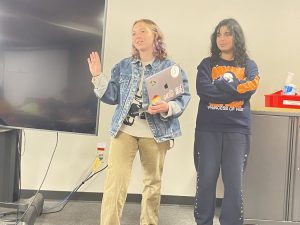 Two students, Sreejita Patra and Kiesen Williams, were able to use some of the grant to travel to Kentucky with UW Odyssey Project to research and produce a documentary on the subject of the Family Scholar House. The Family Scholar House is a solutions model pioneered in Kentucky that offers nontraditional adults seeking degrees heavily subsidized housing. Patra and Williams could gain insight into the Scholar House’s success in Kentucky to consider how a similar model could be implemented in Madison.
Patra, who also wrote an article for The Cap Times about the housing model, shared her experience working with Odyssey and traveling to Kentucky to explore the Scholar House, noting that exposing herself to Madison community efforts beyond the UW campus was a very valuable experience as a student reporter.
“One really important thing for UW students, especially journalists, is to get out of this bubble,” Patra says. “It was just really meaningful work to be able to step out into the community … and kind of learn this story about Madison and the work that’s related to our school and related to our city that, I think, you don’t always get in a regular journalism class.”
Two students, Sreejita Patra and Kiesen Williams, were able to use some of the grant to travel to Kentucky with UW Odyssey Project to research and produce a documentary on the subject of the Family Scholar House. The Family Scholar House is a solutions model pioneered in Kentucky that offers nontraditional adults seeking degrees heavily subsidized housing. Patra and Williams could gain insight into the Scholar House’s success in Kentucky to consider how a similar model could be implemented in Madison.
Patra, who also wrote an article for The Cap Times about the housing model, shared her experience working with Odyssey and traveling to Kentucky to explore the Scholar House, noting that exposing herself to Madison community efforts beyond the UW campus was a very valuable experience as a student reporter.
“One really important thing for UW students, especially journalists, is to get out of this bubble,” Patra says. “It was just really meaningful work to be able to step out into the community … and kind of learn this story about Madison and the work that’s related to our school and related to our city that, I think, you don’t always get in a regular journalism class.”
 By working with these organizations, the students honed their storytelling skills, but perhaps more importantly, learned how to navigate community partnerships during difficult times. All of their work from the semester is published in Madison Commons, a hyperlocal community journalism site project powered by UW’s School of Journalism and Mass Communication.
Community-based learning is intended to be a high-impact educational experience that integrates meaningful community engagement to deepen student learning while also responding to community-identified priorities. For Robinson, the nature of this course provides no shortage of opportunities for students to engage in impactful, hands-on work in the community.
“The more real-world experience that they can have, the more they get a sense for the different kinds of challenges that come up that you can’t really replicate in other kinds of ways,” Robinson says, adding that traditional classroom settings can’t always foster this type of tangible learning.
In the spring, Robinson will reintroduce the program as a four-credit course for SJMC students and, simultaneously, as a three-credit course for UW Odyssey students. There will be 15 students from each department paired together.
Robinson has been involved in community-based learning at UW for a decade and credits the Morgridge Center for providing essential infrastructural support for innovative learning, such as paying the transportation costs to get to the community sites.
“Morgridge Center is doing so much good in all kinds of communities, and I would not be able to do any of this work … without the assistance they give us,” Robinson says.
By Sophie Wooldridge
By working with these organizations, the students honed their storytelling skills, but perhaps more importantly, learned how to navigate community partnerships during difficult times. All of their work from the semester is published in Madison Commons, a hyperlocal community journalism site project powered by UW’s School of Journalism and Mass Communication.
Community-based learning is intended to be a high-impact educational experience that integrates meaningful community engagement to deepen student learning while also responding to community-identified priorities. For Robinson, the nature of this course provides no shortage of opportunities for students to engage in impactful, hands-on work in the community.
“The more real-world experience that they can have, the more they get a sense for the different kinds of challenges that come up that you can’t really replicate in other kinds of ways,” Robinson says, adding that traditional classroom settings can’t always foster this type of tangible learning.
In the spring, Robinson will reintroduce the program as a four-credit course for SJMC students and, simultaneously, as a three-credit course for UW Odyssey students. There will be 15 students from each department paired together.
Robinson has been involved in community-based learning at UW for a decade and credits the Morgridge Center for providing essential infrastructural support for innovative learning, such as paying the transportation costs to get to the community sites.
“Morgridge Center is doing so much good in all kinds of communities, and I would not be able to do any of this work … without the assistance they give us,” Robinson says.
By Sophie Wooldridge
This story is a part of a series highlighting recent recipients of the center’s community-based learning and research grants, which support the development of new community-based learning courses and community-based research projects. Check out our story on the Disability Justice Collective, a UW–Whitewater research group partially funded by a grant from the Morgridge Center.
L-R: Kiesen Williams and Sreejita Patra presenting their documentary at an event last April with UW Odyssey and housing nonprofits.
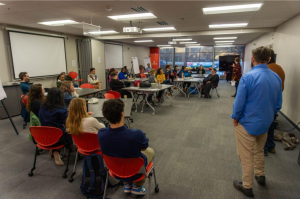
In April, UW–Madison Odyssey Project and Madison Commons cohosted a community event to discuss a call to action for a family scholar house in Madison. This housing would support student parent families. Photo by Jonás Tijerino.
This story is a part of a series highlighting recent recipients of the center’s community-based learning and research grants, which support the development of new community-based learning courses and community-based research projects. Check out our story on the Disability Justice Collective, a UW–Whitewater research group partially funded by a grant from the Morgridge Center.